



Chinese Equipment Brands Vs Western Brands: Is The Gap Closing?
 0 likes
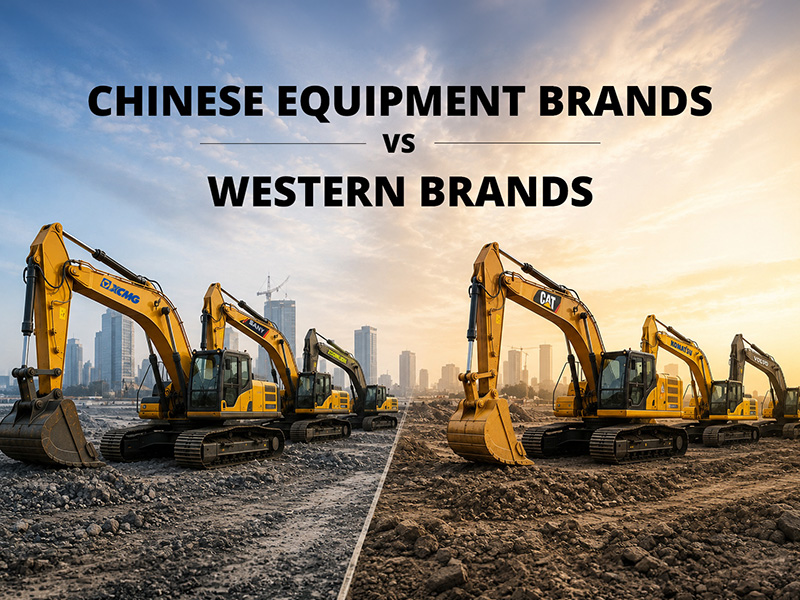
Yes, meaningfully - but not evenly across every category. On price, Chinese brands like XCMG, SANY, and Zoomlion remain 20–50% cheaper than comparable Caterpillar, Komatsu, or Volvo CE machines. On build quality and technology, the gap has narrowed enough that it's no longer the deciding factor it was a decade ago. Where Western brands still hold a clear edge is dealer density, parts availability, and resale value - and in the Middle East specifically, that infrastructure gap matters more than the spec sheet.
The Perception Gap, and How It's Shifted
A decade ago, "Chinese equipment" was shorthand in much of the industry for a machine you bought to run hard and sell cheap, not one you built a fleet standard around. That perception was earned in part by genuine build-quality gaps in hydraulics, engine longevity, and componentry. It's also outdated in important ways. Chinese OEMs have spent the last several years investing heavily in R&D, expanding overseas manufacturing and service footprints, and - in XCMG's case - establishing regional assembly and support operations closer to markets like North Africa and the Gulf. The result is a narrower quality gap than the reputation still suggests, even as the reputation itself takes longer to catch up.
Build Quality and Technology: Where the Gap Has Actually Closed
The clearest technology gains from Chinese manufacturers have come in electrification and telematics - areas where several Chinese OEMs have moved aggressively, in some cases matching or leading Western competitors on electric and hybrid drivetrain rollouts for construction machinery. On core mechanical reliability, brands like SANY and XCMG have closed real ground in their volume categories - mid-size excavators in the 6–50 tonne range particularly - while smaller or newer manufacturers in the same market still show more variability. It's not a uniform story: buyers comparing specific models should still weigh componentry and warranty terms model by model rather than assuming brand-wide parity.
Price: Still the Clearest Differentiator
This is where the gap hasn't closed at all. Chinese equipment continues to undercut Western brands substantially on upfront purchase price - commonly cited in the 20–50% range depending on category and model - and that gap is the primary reason Chinese OEMs have taken meaningful share in cost-sensitive segments across Africa, Southeast Asia, and parts of the Middle East. Parts and service cost tell a more mixed story regionally: parts availability for the major Chinese brands has improved substantially in markets where they've established genuine dealer presence, but can still lag Caterpillar or Komatsu in areas without a strong local network.
Resale Value: Narrowing, Slowly
Caterpillar retains a clear resale advantage - often cited around 55–70% of value after five years, against a wider and generally lower range for Chinese brands, though that range varies a great deal by model, region, and documentation. The gap is narrowing on the more established Chinese brands, particularly where machines carry full dealer service history, but it hasn't closed. Buyers planning to trade or sell within five years should weight this factor more heavily than buyers planning to run a machine to the end of its working life, where the resale gap simply matters less.
Dealer and Service Network Presence in the Middle East and Africa
This is arguably the most important regional factor and the one spec comparisons tend to skip. Caterpillar's dealer network in the region numbers in the thousands of locations globally with deep MEA coverage; the major Chinese OEMs have expanded fast but are still building out that density, particularly outside the largest urban and megaproject corridors. On an active site in a remote part of a giga-project zone, the practical question isn't which excavator has the better spec sheet - it's which brand can get you a hydraulic pump or an undercarriage component within days rather than weeks. That answer still tilts toward the established Western and Japanese brands in a lot of the region, though it's shifting as Chinese OEMs build out regional parts and service infrastructure to support their growing installed base.
What This Means for Your Buying Decision
For short-term or budget-constrained projects where the machine will be sold or retired within a few years, the price advantage of Chinese equipment is hard to argue with, provided the dealer in your specific market can actually support it after the sale. For long-term fleet standardization, especially in remote or high-utilization applications where downtime is expensive, the calculation shifts toward brands with denser regional service coverage - which today still leans Western and Japanese, though that lean is less pronounced than it was five years ago. Warranty terms, not just brand name, are worth reading carefully either way: coverage length and what it actually includes varies enough between manufacturers to change the real cost comparison.
There's no single winner here - the right brand depends on your project timeline, your tolerance for parts lead time, and how much weight you put on resale value versus upfront cost. Compare current listings across both Chinese and Western equipment brands on the marketplace to see current pricing and availability in your region.
Leave a reply